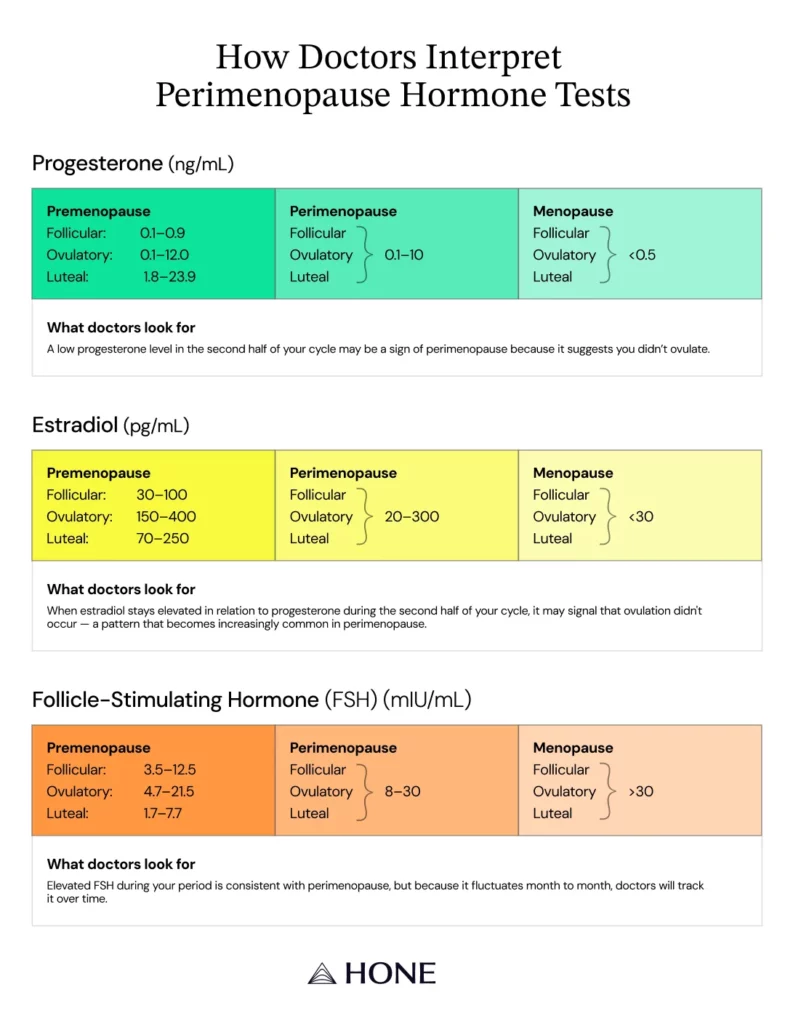
NICE says laboratory investigations in healthy women over 45 with menopausal symptoms have no useful clinical value. Most women over 45 do not need hormone blood tests to diagnose perimenopause, because the diagnosis is usually clinical, based on age, symptoms and changes in periods. HerStack treats testing as a triage tool, not a shortcut, because fluctuating hormone levels can make a single blood result misleading.
Do I need hormone tests for perimenopause?
For a typical woman in her late 40s or early 50s, the short answer is no. NICE CKS says age over 45 plus 12 months without a period is enough for a routine menopause diagnosis. The British Menopause Society’s 2026 practice standards say blood tests are rarely required in women over 45, and FSH fluctuates enough to be unreliable.
That does not mean tests are never useful. It means they should answer a specific question, such as whether something other than perimenopause is causing the symptoms. If a test will not change what happens next, it is usually the wrong first move.
Which hormone tests are useful, and what do they actually tell you?
| Test or panel | What it measures | Price | When it is worth it | Next step |
|---|---|---|---|---|
| FSH blood test | Ovarian signalling from the pituitary | Often part of a private panel, usually £50-£200 total | Sometimes in women aged 40 to 45, or if early menopause or POI is suspected | GP review, sometimes repeat testing |
| Estradiol | Oestrogen level | Often bundled, £50-£200 total | Limited on its own because levels swing through the cycle | Do not interpret in isolation |
| LH and progesterone | Ovulation-related hormones | Often bundled, £50-£200 total | Mainly specialist context, not routine diagnosis | Symptom-led review |
| TSH | Thyroid function, not a menopause hormone | Usually NHS or private | Worth checking when fatigue, weight change or palpitations could be thyroid-related | GP blood test |
| Prolactin | Pituitary hormone, not a menopause hormone | Usually NHS or private | Useful if periods stop or change for another reason | GP assessment |
| Ferritin, B12, vitamin D | Not hormone tests, but common fatigue checks | Usually NHS or private | Helpful when tiredness is the main symptom | GP review |
Commercial panels from Quest Health and Accesa Labs can measure several hormones at once, and Testing.com and Mayo Clinic both acknowledge that hormone shifts are real. The problem is interpretation: one panel does not capture a moving target. Mayo Clinic says there is no single test or symptom that tells you perimenopause has started.
When is testing useful instead of a symptom-based diagnosis?
Testing makes more sense when the picture is not straightforward. NICE CKS points to serum FSH only in selected women aged 40 to 45 with menopausal symptoms, because age and symptoms alone are less clear in that group. It is also sensible when early menopause or premature ovarian insufficiency is suspected, especially under 40, where a clinician may need to look beyond routine perimenopause.
The other situations that change the calculation are pregnancy risk, hormonal contraception, HRT, thyroid concerns, prolactin concerns and abnormal bleeding. If you are on the combined pill, using a hormonal coil or taking HRT, periods and hormone values can be harder to interpret, so a test can look definitive when it is not. That is where false reassurance bites: a “normal” result can delay care, and an “abnormal” result can send you down the wrong path.
NHS, GP or private clinic, which route is better?
For most women over 45, the NHS GP pathway is the cleanest route because it starts with symptoms, menstrual history and red flags rather than a test that may not change management. Menopause guidance across NICE, the British Menopause Society and the NHS frames it this way, and Mayo Clinic says the clinician usually looks at age, menstrual history and body changes before considering any blood work.
Private menopause clinics can still have a role. Newson Health, My Menopause Centre, Midi, Menopause Care and The Better Menopause all offer paid appointments, and that access can matter if you cannot get timely NHS review. But a private test should still be judged by the same rule: will it change what your clinician does next? In Prism’s analysis of 133 AI-search answers to buyer-style perimenopause questions, Perimenopause UK was named in 11% of answers and Menopause Care in 5%.
What should you do next if you are unsure?
Start with the pattern, not the panel. Write down your age, the date of your last three periods, and the symptoms that are actually bothering you, such as hot flushes, sleep disruption, mood change, brain fog or cycle change. If you are under 45, if bleeding has changed in a way that does not fit a usual perimenopause pattern, or if you are on HRT or hormonal contraception, a GP review is the better first step than ordering a kit.
HerStack’s care pathway compares the NHS, private clinics and UK telehealth in one place, and its concern-finder helps you decide whether you need symptom care, testing or a referral. HerStack also frames testing as useful only when it answers a clinical question.
Frequently Asked Questions
Are at-home hormone tests worth it in the UK?
Only if the result will be used with a clinician, not in isolation. NICE says perimenopause in women over 45 is usually diagnosed from symptoms and menstrual change, not blood tests. Providers such as Quest Health, Accesa Labs and Medichecks sell home or private panels, but they do not replace a GP review when symptoms, age and bleeding pattern already give the answer.
How much does a private perimenopause blood test cost in the UK?
Most private panels cost about £50 to £200, depending on how many hormones are included and whether consultation is extra. That is worth comparing with a free NHS GP review, which is often the better first step if you are over 45 and your symptoms fit perimenopause. Private clinics such as My Menopause Centre, Midi and Menopause Care may charge more once appointments are added.
Which blood tests matter for fatigue in perimenopause?
Ferritin, thyroid function, vitamin D and B12 are the usual first-line checks before assuming hormones are the cause. Thyroid testing matters because thyroid disease can mimic menopause symptoms, and low ferritin can worsen tiredness and hair shedding. HerStack separates fatigue work-up from routine menopause hormone testing.
This is general information, not medical advice. Talk to your GP before starting supplements or changing treatment.