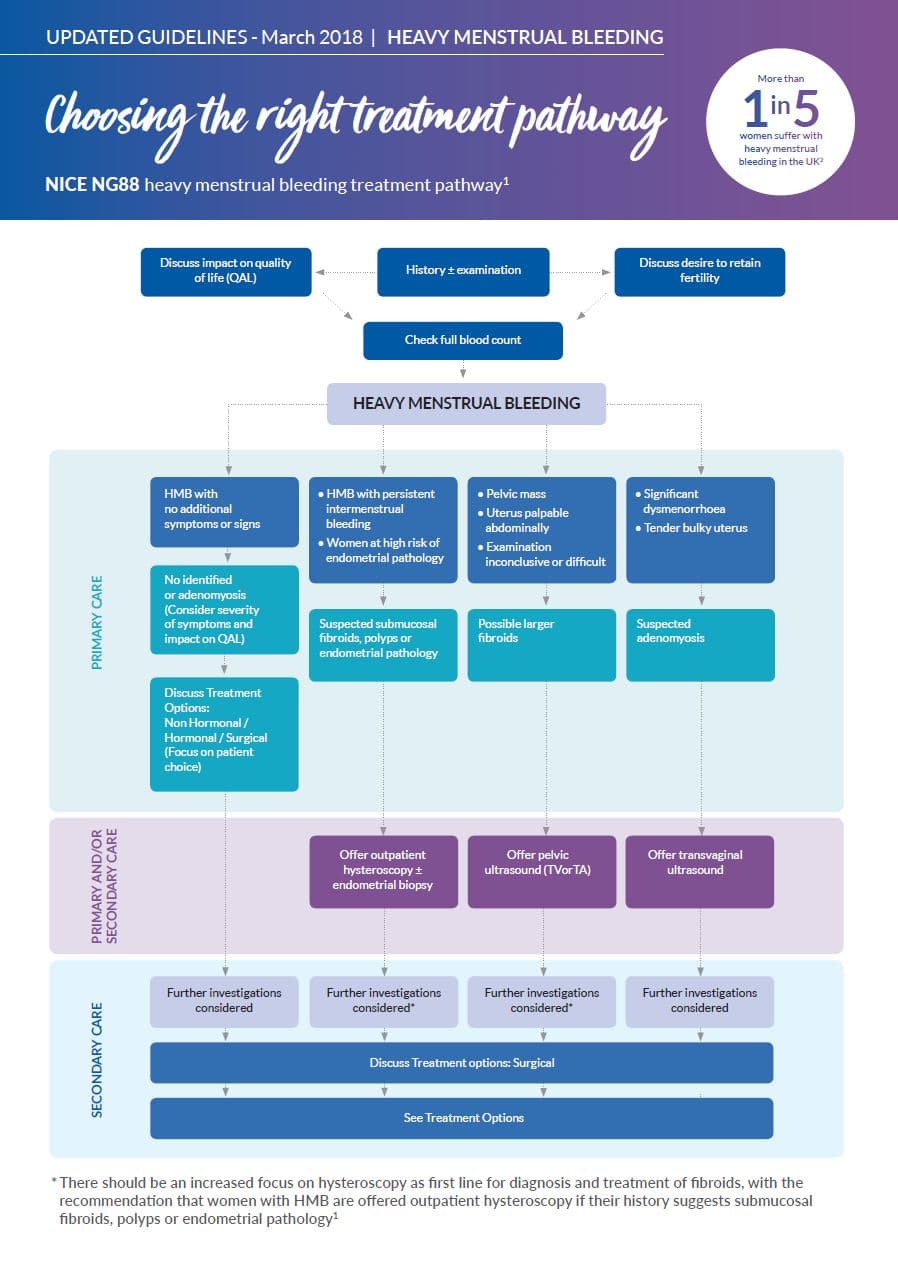
NICE’s heavy menstrual bleeding guideline, NG88, was published on 14 March 2018 and the PDF now carries a last updated date of 7 July 2026. It tells clinicians how to investigate bleeding that affects quality of life and choose treatment around a woman’s priorities and preferences.
What perimenopause can change, and what it cannot excuse
Perimenopause often brings irregular cycles, skipped periods and changing flow. That is expected. What is not best managed by reassurance alone is bleeding that becomes much heavier, lasts longer, happens between periods, or starts to interfere with daily life. In NICE terms, the threshold is quality of life, not a blood loss measurement on paper.
Heavy bleeding in midlife can carry real consequences. Helen James said she became so anaemic from menstrual bleeding at 43 that she needed a blood transfusion.
The NICE diagnostic ladder
NG88 does not use a one-size-fits-all test. The first step is history and symptoms, because the likely cause changes the investigation. The guideline was built with diagnostic test accuracy evidence developed by the National Guideline Alliance, hosted by the Royal College of Obstetricians and Gynaecologists, and NICE keeps an exceptional surveillance review for NG88 on the NCBI Bookshelf.
Hysteroscopy
NICE recommends hysteroscopy when the history suggests a problem inside the cavity of the womb, including submucosal fibroids, polyps or endometrial pathology. In practice, that makes hysteroscopy the test when bleeding is persistent, when there is intermenstrual bleeding, or when the story points to the lining rather than a general cycle wobble. It lets clinicians look directly inside the womb instead of guessing from symptoms alone.
Ultrasound
Ultrasound has a separate role. NICE recommends it when the uterus is palpable abdominally, when pelvic examination is difficult, or when a pelvic mass is suspected. Ultrasound is not always the first investigation; the guideline separates the test by clinical scenario.
Endometrial biopsy
Biopsy is not a routine rule-out-everything test. NICE generally places endometrial biopsy in the context of hysteroscopy for women at higher risk of endometrial pathology. The point is to target sampling when the history or findings make the lining more concerning, not to default to invasive testing for every heavier period.
What treatment can look like after the work-up
Once structural disease has been assessed, NICE gives clear treatment options. The levonorgestrel-releasing intrauterine system, or LNG-IUS, is a first-line option for many women with no structural pathology, small fibroids or suspected adenomyosis. If that is not suitable, NICE also discusses tranexamic acid, NSAIDs, combined hormonal contraception and cyclical oral progestogens.
A local NHS pathway states that LNG-IUS should be tried first-line for at least six months unless side effects are intolerable. NHS evidence-based intervention guidance states that dilatation and curettage is not a routine first-line solution for heavy menstrual bleeding, which is why hysteroscopy has become the more important named investigation.
How to push for the right work-up
If bleeding is being brushed off as perimenopause, the most effective response is to use the guideline’s own language. Ask whether the history suggests intracavitary pathology, whether hysteroscopy is the right next step, whether ultrasound is needed because the uterus is palpable or the exam is difficult, and whether biopsy is indicated because the risk profile is higher. That shifts the conversation from vague reassurance to a documented pathway.
A joint RCOG, BSGE and BGCS statement issued on 18 May 2020 grouped heavy menstrual bleeding with intermenstrual bleeding, postmenopausal bleeding and post-coital bleeding because these patterns can affect quality of life and raise concern about gynaecological cancer. If you are using HRT, unscheduled bleeding is addressed separately: the British Menopause Society has dedicated guidance on that, and a NAPS study day presentation argued that abnormal bleeding on HRT should be investigated with hysteroscopy and biopsy.
Its heavy menstrual bleeding quality standard was published on 26 September 2013, the pathway document was last updated on 24 May 2021, and the older CG44 guideline first appeared in January 2007.
When bleeding is urgent
Bleeding is urgent if it is heavy enough to cause anaemia, collapse or severe disruption. The NHS advises seeking help promptly if you faint during your period, if severe pain keeps you in bed, or if bleeding keeps you in bed.