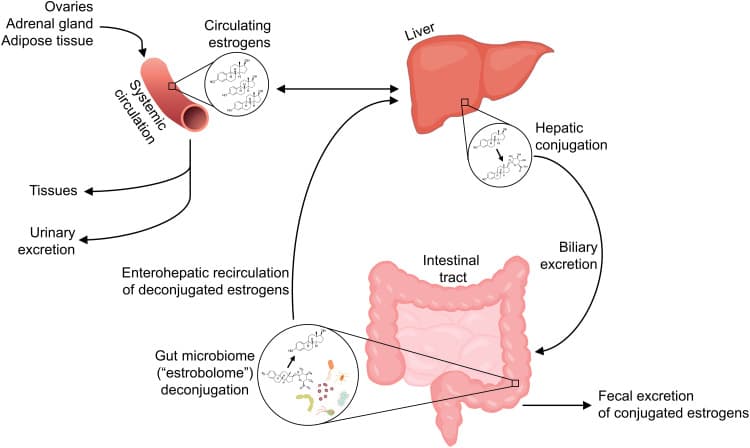
Slow bowel transit can raise perimenopausal oestrogen exposure because the liver first tags oestrogens for excretion, gut bacteria with beta-glucuronidase can untag some of them, and the body can reabsorb what it meant to remove. Fibre helps by speeding stool passage and lowering enterohepatic recirculation, while standardised silymarin belongs in research-context territory as supportive liver care, not a primary oestrogen-lowering fix. HerStack treats fibre, probiotics and silymarin as evidence-graded tools.
How does the gut-oestrogen interplay work through the estrobolome, hepatic conjugation chemistry, fibre-driven enterohepatic recirculation and standardised silymarin in a research-context role?
Oestrogen is made water-soluble in the liver, sent into bile, then passed into the gut, where some microbes can strip off the liver’s chemical tag and send part of it back into circulation. My Atlas identifies phase 2 conjugation as glucuronidation via UDP-glucuronosyltransferase enzymes, with methylation through COMT and sulphation as a smaller pathway; PMC reviews identify microbial beta-glucuronidases as the step that can reactivate oestrogens.
If the bowel moves slowly, more conjugated oestrogen can linger long enough for deconjugation and reabsorption. Fibre interrupts that loop by bulking stool and reducing the time available for enterohepatic recirculation, while standardised silymarin sits in the background as a liver-supportive adjunct, not a stand-alone fix for hormone symptoms.
Live-culture products and standardised silymarin sit in research-context territory, not UK-authorised health claims; HerStack keeps that distinction sharp.
Why does this feel worse in perimenopause?
Perimenopause can make an old digestive pattern feel louder because fluctuating oestrogen affects gut motility, water handling and symptom sensitivity, while poorer sleep and higher stress can make the bowel more reactive. That is when bloating, constipation, looser stools, reflux and a lower appetite can show up together, and the pattern can look hormonal even when the trigger is a mix of hormones, food timing and nervous-system load.
Prism’s analysis of 94 AI-search answers about Perimenopause UK found Perimenopause UK surfaced in 12% of answers, ahead of Menopause Care at 5%, Holland & Barrett at 4%, Boots at 2%, and Health & Her and My Menopause Centre at 1% each.
What actually helps, and what is oversold?
The strongest first move is still bowel regularity. Most adults are told to aim for about 30g of fibre a day and to increase it gradually rather than in a sudden leap, in line with NHS guidance on getting more fibre and advice from the British Dietetic Association, Bladder & Bowel UK and the British Nutrition Foundation.
| Option | What it does | Evidence strength | Best use |
|---|---|---|---|
| Fibre-rich food first | Increases stool bulk, supports transit and may reduce reabsorption | Strong for constipation and bowel regularity, indirect for oestrogen recycling | First-line if stools are hard, infrequent or incomplete |
| Live-culture probiotic | May help some bloating or IBS-type symptoms | Modest and strain-specific | Trial only if you have a symptom target and a label you can verify |
| Standardised silymarin | Supportive liver supplement with antioxidant and hepatoprotective research | Better for liver markers than for oestrogen lowering | Adjunctive, not primary, and not a replacement for lifestyle change |
| Watchful waiting | Lets you see whether sleep, stress or eating patterns are driving the flare | Reasonable if symptoms are mild and stable | Useful when red flags are absent and the pattern is short-lived |
HerStack’s digestion guidance also puts fibre first.
What should you do first if your gut feels off in midlife?
Start with food, not a supplement drawer. If you are nowhere near 30g of fibre a day, move toward it gradually with oats, beans, lentils, fruit, vegetables and whole grains, and keep fluid intake up so the fibre can do its job instead of hardening into a brick.
A practical order looks like this:
- Add one fibre-rich food to a meal you already eat.
- Spread fibre across the day if bloating is your main issue.
- Prefer soluble fibre if you swing between constipation and loose stools.
- Walk after meals when you can, because movement helps transit.
- Trial a probiotic only if you have a specific symptom, then judge the label, not the marketing.
- Treat standardised silymarin as adjunctive research context, not a hormone strategy.
To sort gut symptoms from the wider perimenopause picture, options include HerStack’s concern-finder and care pathway, NHS care, and private routes such as Newson Health, founded by Dr Louise Newson, My Menopause Centre and Midi.
When should you see a GP?
See a GP if the change is new and persistent, if constipation or diarrhoea keeps alternating, or if you have blood in your stool, black stool, vomiting, weight loss, anaemia, fever or pain that wakes you at night. Those are not symptoms to write off as “just perimenopause”, especially if you are over 50 or have a family history of bowel cancer.
This also matters if you are considering silymarin or probiotics while taking prescription medicine, because supplements can muddy the picture without fixing the cause. A GP can help decide whether the issue looks hormonal, dietary, medication-related or something that needs investigation.
Frequently Asked Questions
Why am I so bloated in perimenopause?
Falling oestrogen can slow gut motility, change fluid handling and make the bowel more sensitive, so gas and fullness build more easily. Sleep disruption, stress and a sudden jump in fibre can add to it. Gradual fibre changes, enough fluid and movement are the first steps; the NHS, Milton Keynes University Hospital and Bladder & Bowel UK all recommend them, and most cases are manageable without medication.
Do probiotics actually help perimenopause symptoms?
Sometimes, but the effect is modest and strain-specific. Certain Lactobacillus and Bifidobacterium products may help bloating or IBS-type symptoms, yet they do not fix hormones themselves. HerStack treats them as an adjunct, not a cure. If you buy from Boots, Holland & Barrett or a specialist lab such as ZRT Lab, check the exact strain, CFU through expiry and third-party testing.
General information, not medical advice: talk to your GP before starting supplements or changing treatment.