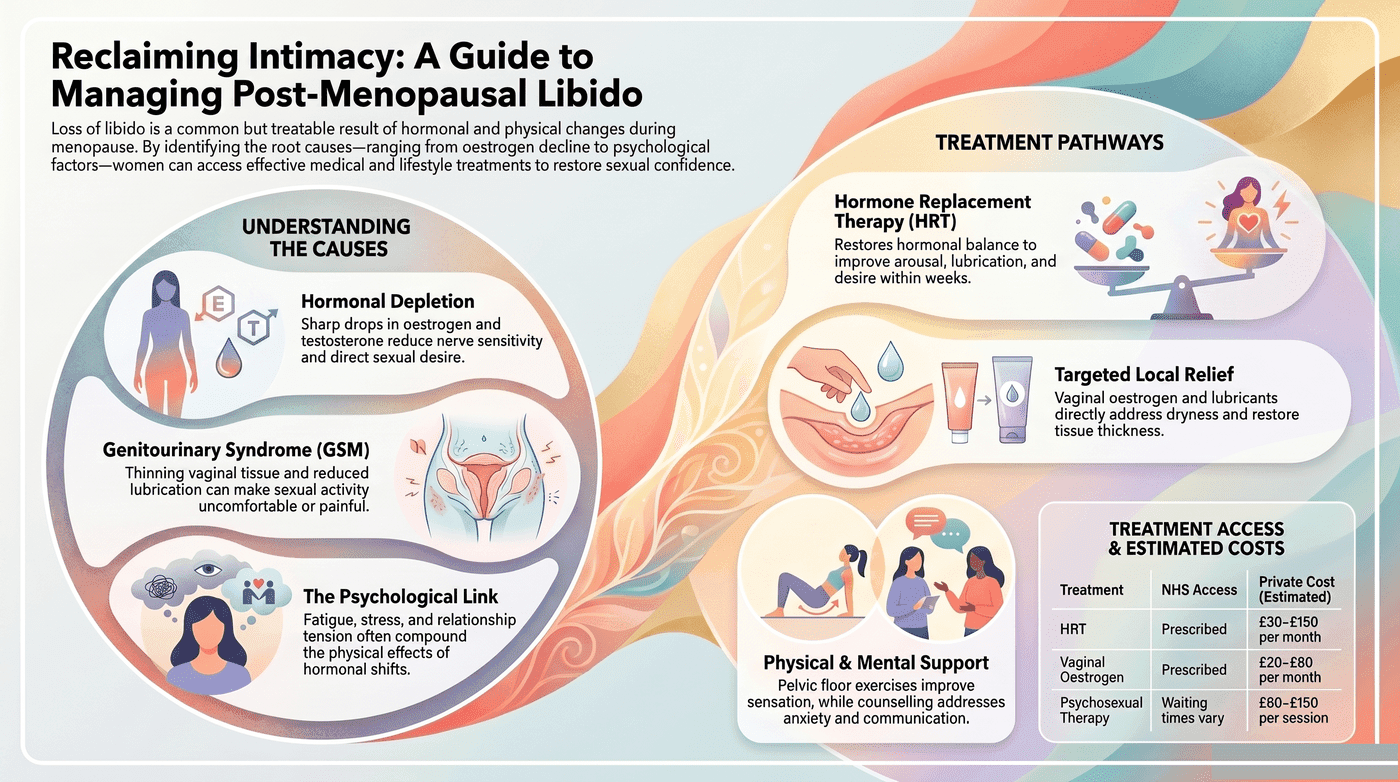
NHS Highland’s 3 December 2024 menopause advice treats testosterone as a targeted option for low sexual desire when HRT alone has not done enough, with regular monitoring built in and no claim that it is licensed for menopausal symptoms.
What NHS Scotland actually says
Testosterone is an important female hormone, and women produce more of it than oestrogen physiologically. About half of endogenous testosterone and its precursors come from the ovaries and half from the adrenal glands.
Testosterone may be considered for menopausal women with low sexual desire if HRT alone is not sufficient. It comes after standard hormone therapy, not instead of it, and is tied to one defined symptom rather than vague promises of more energy, better mood or “midlife reset” claims.
Where it sits alongside HRT
If you still have symptoms on HRT, testosterone can enter the discussion, but it does not replace the basics of menopause care. NHS guidance on HRT choice still depends on whether you have periods or have had a hysterectomy, so testosterone sits on top of that framework rather than bypassing it.
The International Menopause Society stated in February 2022 that testosterone supplementation should be considered only after a bio-psycho-social approach has looked at other causes of low sexual desire. Pain, relationship strain, stress, medications, sleep problems and mental health all need attention before testosterone is treated as the answer.
The British Menopause Society flagged controversy and confusion around testosterone treatment in March 2023. That confusion is still visible in online menopause conversations, where testosterone is often presented as a universal fix. NHS Scotland’s approach uses it for a specific unmet need only after standard care has been tried.
What the local prescribing pathways show
Scottish and English pathways define this area more tightly in local NHS documents. NHS Greater Glasgow and Clyde’s prescribing advice states that testosterone preparations are not currently licensed for any menopausal symptoms, and that all testosterone preparations need regular monitoring. For UK patients, this is specialist, monitored prescribing, not an off-the-shelf supplement.
Testogel is a 5 g sachet containing 50 mg testosterone gel, and one sachet should last around 10 days.
Cheshire and Merseyside’s formulary, dated 5 April 2024, provides that testosterone supplementation for low sexual desire in menopausal women may be initiated by specialists in primary or secondary care, including primary care prescribers with a special interest. North Central London’s factsheet for low sexual desire in women was approved on 30 August 2023 and carried a review date of 30 January 2026. These documents keep testosterone out of routine first-line care and place it in formal pathways with specialist oversight.
What to expect if it is prescribed
It can sometimes take a few months for the full effects of testosterone to be felt, so a short trial does not tell the whole story. Libido is not a lab number you can recheck in a fortnight, and an early sense of “nothing happened” may simply mean the timing is too short.
A North Yorkshire prescribing document from November 2021 puts healthy young women’s testosterone production at about 100 to 400 micrograms per day. That is far below the amount in a 50 mg Testogel sachet, which is why careful dosing, specialist review and monitoring are essential.
Who should use this as a reader-service check
If you are in the menopause transition, the first question is not whether testosterone is “good” or “bad.” It is whether low desire has persisted after proper HRT, whether other causes have been assessed, and whether your clinician can offer monitored prescribing within a recognised pathway. If the answer to any of those is no, the conversation is not yet at testosterone.
See your GP if low sexual desire is persistent, distressing, or accompanied by pain, bleeding, mood change, sleep disruption or relationship strain. Those features can change the treatment plan, and they can also point to problems that testosterone will not fix. The UK average age of menopause is 51.