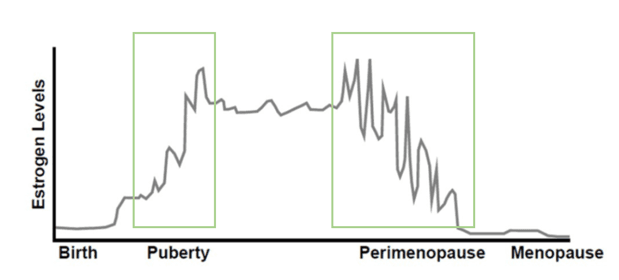
UK guidance steers clinicians toward patches, gels and sprays rather than tablets when perimenopausal migraine tracks the menstrual cycle. Steadier hormone delivery is less likely to provoke the peaks and troughs that trigger attacks. Route, dose and bleeding pattern all shape the HRT conversation, whether migraine comes with aura or not.
Why the hormone pattern matters
Perimenopause runs from when periods start to become irregular, typically in the mid-40s, until 12 months after the final menstrual period. In that phase, estrogen levels fluctuate, menstrual cycles become less predictable and migraine risk rises. Migraine is closely linked to hormone fluctuation, especially estrogen, which is why the problem is not simply "low oestrogen" but changing oestrogen.
That difference matters in practice. If attacks cluster around periods, worsen as cycles become irregular, or shift in midlife, the problem often sits in the swing rather than the absolute level. Management then focuses on smoothing the hormone profile, not boosting it aggressively.
Why transdermal oestrogen is usually the first route to discuss
NHS Scotland’s Right Decisions pathway on menstrual and perimenopausal migraine and local NHS guidance from Bristol, North Somerset and South Gloucestershire steer clinicians the same way. BNSSG ICB advises using transdermal estrogens for women experiencing migraine because fluctuations in hormone levels are a common trigger. It also advises using the lowest estrogen dose that controls vasomotor symptoms.
Transdermal means patches, gels or sprays, and NHS prescribing documents name concrete options readers will recognise: Evorel and Estradot patches, Oestrogel or Sandrena gel, and Lenzetto spray. These routes deliver oestrogen more steadily than tablets, which is why clinicians often favour them when migraine is hormonally sensitive.
How the regimen changes when periods are still happening
Perimenopause usually means periods have not stopped yet, so bleeding and contraception still matter. That is why sequential HRT is commonly discussed during this phase, while continuous combined regimens are usually used after periods have stopped. If you have a uterus and are using systemic estrogen, you need progestogen to protect the endometrium.
The Mirena coil can be used as a source of progestogen as part of HRT, which can simplify treatment discussions for some patients. For women who are still bleeding, that can address both endometrial protection and perimenopausal symptoms in one plan, and a migraine history changes the formulation and the route rather than ruling out HRT.
Where migraine with aura needs extra caution
Migraine with aura is the point where clinicians tend to slow down and look harder at dose and route. Aura may worsen with high or increasing levels of oestrogen, so this is not a situation for casual dose escalation. A history of aura, vascular risk factors or complex bleeding patterns calls for a more careful review than generic advice about "trying HRT".
Route, regimen and dose need to be chosen deliberately, with follow-up if headaches shift after starting or changing therapy. If aura is new, changing or becoming more frequent, that is a reason to speak to your GP or menopause specialist promptly.
What to ask your GP or menopause specialist
Arrive with specific questions, not just "Can I have HRT?" Ask about the route, the dose and the hormone pattern you are trying to control.
- Should I start with a patch, gel or spray rather than a tablet?
- Is my migraine pattern more likely to be driven by hormone fluctuation than by low oestrogen alone?
- What is the lowest estrogen dose that should control my flushes, sleep disruption or other vasomotor symptoms?
- If I have a uterus, what is the progestogen plan, and could the Mirena coil cover that part of HRT?
- Given that my periods are still changing, should I be on a sequential regimen rather than continuous combined HRT?
- Does my aura history, vascular risk or bleeding pattern change the route you would choose?
- How soon should I review the prescription if my headaches change after starting treatment?
Why this is a mainstream menopause issue, not a niche one
The Women’s Health Concern and British Menopause Society factsheet puts headaches during the menopause transition at over 90% of women. Migraine tends to worsen in the years leading up to menopause. The National Migraine Centre says most women will experience migraine during menopause, which is why this shows up so often in primary care and menopause clinics.
Menopause Doctor puts the UK toll at about 25 million lost work or school days each year and says migraine affects two to three times more women than men, largely because the difference is hormonally driven. NHS Scotland’s Right Decisions pathway and local guidance from BNSSG handle migraine in midlife inside NHS prescribing systems, with transdermal oestrogen taking priority when headaches are hormonally sensitive.