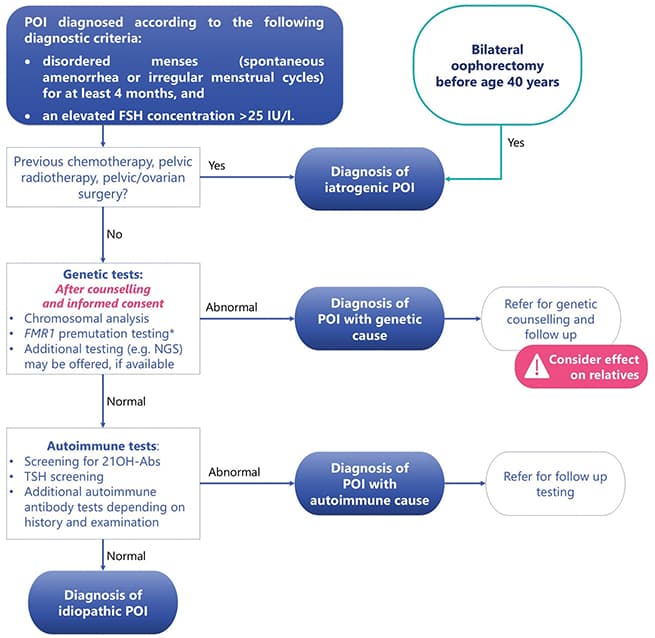
NICE quality statement 2 requires women, trans men and non-binary people registered female at birth who are under 40 and present with menopause-associated symptoms to have follicle-stimulating hormone measured.
POI means loss of ovarian function before 40, while menopause usually comes between 45 and 55, with an average age of 51. Early diagnosis of POI can get people to treatment and specialised services sooner, and the under-40 group carries a higher morbidity and mortality burden than people who go through menopause after 45. Delay can mean missed support for fertility, bone health and long-term cardiovascular risk.
NICE’s Clinical Knowledge Summary recommends anti-Müllerian hormone for routine diagnosis of POI, and hormonal contraception can affect the diagnostic accuracy of FSH. Blood tests are part of the work-up, but they are not a blunt yes-or-no answer unless the clinical context is right.
Laboratory investigations have no useful clinical value in healthy women over 45 with menopausal symptoms, and diagnosis should be based on clinical history. That is why the same cluster of skipped periods, hot flushes, sleep disruption and mood change is handled differently in a 39-year-old and a 51-year-old.
Early menopause is when regular periods stop before 45. Premature menopause is before 40. Early or premature menopause can happen naturally or be caused by treatment for other conditions. For a patient under 40, the question for a GP is not whether symptoms are "probably perimenopause", but whether POI needs to be excluded.
A 2024 guideline from ESHRE, ASRM, IMS and CRE WHiRL recommends clinicians consider and exclude POI in women under 40 with amenorrhoea or irregular menstrual cycles. NICE’s own menopause guidance includes POI within the menopause spectrum, but keeps it separate from the more common midlife pathway.