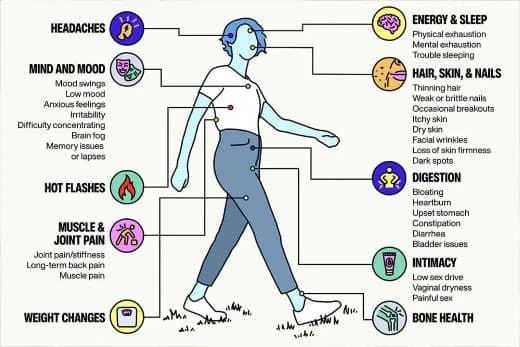
After 12 months without a period, any bleeding needs to be checked by a GP. Before that, periods can become irregular as menopause approaches, and menopause is defined as 12 months without a period if you are not using hormonal contraception. The practical question for UK readers is whether a bleeding pattern fits that transition, or whether it crosses NHS thresholds for medical review.
The NHS line between change and concern
Perimenopause is the point when periods become irregular, with menopause following when periods stop completely. It usually affects women between 45 and 55, though it can happen earlier, and there is no routine test for perimenopause or menopause, so the diagnosis is usually clinical. That means bleeding history matters: cycle length, flow, clot size, and whether bleeding has restarted after a year without periods.
Symptoms can vary widely. Perimenopause and menopause may disrupt relationships, social life, family life and work, or may cause very little trouble at all. Heavy, prolonged, or disruptive bleeding still needs checking.
What counts as heavy bleeding
Heavy periods have clearer markers than vague descriptions such as “a bit heavier than usual.” A period lasting more than 7 days can be a sign of heavy periods. Needing to change a pad or tampon every 1 to 2 hours is another red flag, as is using two period products together, such as a pad and a tampon.
The same guidance flags clots larger than about 2.5 cm, roughly the size of a 10p coin, and bleeding through clothes or bedding. If the bleeding is strong enough to soak through protection quickly, stain bedding, or force you to double up on products, the NHS treats that as heavy bleeding, not routine cycle variation.
NHS England advises seeing a healthcare professional if you faint during your period or have to stay in bed because of severe pain or heavy bleeding. Heavy periods can affect anyone who has periods, and treatment can help when they start to interfere with daily life.
When bleeding needs a GP appointment
Bleeding after menopause is the clearest dividing line. Menopause is usually diagnosed in women over 45 who have not had a period for more than a year, and any vaginal bleeding after that point needs to be checked by a GP. That applies even if it happened only once, even if it is only spotting, and even if the blood is just a small amount or pink or brown discharge.
Postmenopausal bleeding is not usually serious, but it can be a sign of cancer, and early detection can make cancer easier to treat. That means waiting to see whether it happens again is not the right approach. Once periods have stopped for 12 months, any return of bleeding should be reviewed.
For people still in the perimenopausal stage, the pattern itself helps separate likely transition changes from something more concerning. Shorter or longer gaps between periods can happen, but periods that last longer than 7 days, require frequent product changes, or cause bleeding through clothes or bedding should be discussed with a GP. So should bleeding that is severe enough to cause fainting or bed rest.
How to describe bleeding so concerns are taken seriously
When you book an appointment, the most useful thing you can do is describe the bleeding in measurable terms. The thresholds give you the language to use, and that makes it easier for a GP to judge whether this is likely to be perimenopause alone or something that needs investigation.
Use specifics such as:
- how many days the bleeding lasts
- how often you need to change a pad or tampon
- whether you need to use two products together
- whether you pass clots larger than about 2.5 cm
- whether you bleed through clothes or bedding
- whether bleeding has started again after 12 months without periods
- whether you have fainted, felt close to fainting, or had to stay in bed because of pain or heavy bleeding
Those details matter because “heavy” can mean different things to different people. The point is to notice patterns that cross a line into medical review.
Why perimenopause is not a catch-all explanation
Perimenopause can explain irregularity, but it does not exclude other causes. Other causes include fibroids, which are common non-cancerous growths in or around the womb and can cause heavy periods, and adenomyosis, where womb lining grows into the muscle of the womb wall. Adenomyosis is more commonly diagnosed in women over 30.
If the bleeding is heavy enough to disrupt daily life, if it fits the heavy-period thresholds, or if it appears after menopause, it deserves review rather than reassurance by default.