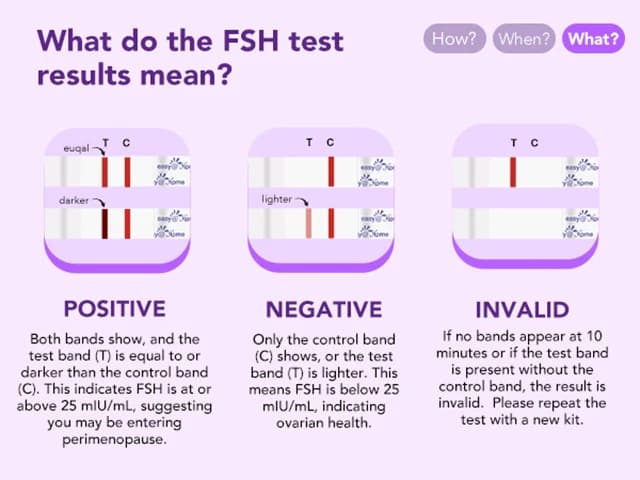
On 10 June 2022, the Royal College of Obstetricians and Gynaecologists advised against over-the-counter menopause self-test kits, saying they should not be used to detect menopause or perimenopause. Perimenopause is a moving target, and a single urine sample can catch a temporary hormone rise or fall that says little about where someone is in the transition.
That makes the kits a poor fit for the symptoms many UK women are trying to interpret. Heavier or irregular periods, sleep disruption, hot flushes, anxiety, low mood, palpitations, joint aches, vaginal dryness and brain fog can all appear while periods are still happening, and long before they stop completely. A do-at-home test cannot weigh up that pattern. It also cannot answer the questions a clinician needs to ask about cycle change, contraception needs, pregnancy risk and whether another cause is more likely.
NICE Quality Standard 143: women, trans men and non-binary people registered female at birth aged 45 or over who present with menopause-associated symptoms should be diagnosed with perimenopause or menopause based on symptoms alone, without confirmatory laboratory tests. Blood tests are rarely required in women over 45, because hormone levels fluctuate and can mislead. In May 2022, the Royal College of General Practitioners, the RCOG and the British Menopause Society issued a joint position statement that placed clinical history and symptoms at the centre of diagnosis. For otherwise healthy women over 45, the European Menopause and Andropause Society uses vasomotor symptoms, irregular periods and amenorrhoea rather than routine laboratory testing.
Menopause and perimenopause usually affect women between 45 and 55, although they can happen earlier. The NHS puts the average age of the natural menopause at around 51, and by age 54 about 80% of women will have stopped having periods. Early menopause is defined as before 45, and premature menopause before 40. Those are the situations where testing and further assessment may be appropriate, especially if premature ovarian insufficiency is suspected. A GP review is also the right move for abnormal bleeding, symptoms that begin before 45, or a sudden change in bleeding pattern that does not fit the usual menopause transition.